


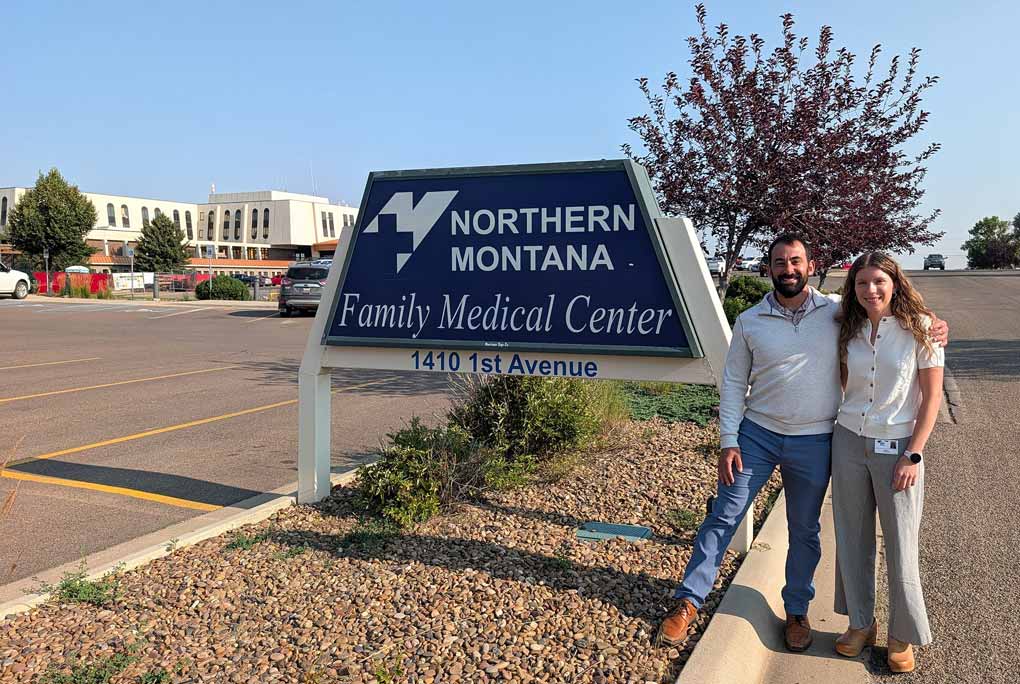
Medical student Ruby Gawarkiewicz recently completed a four-week rotation at Northern Montana Health Care, gaining hands-on clinical experience and exploring different fields she could pursue as a physician. She said she has loved every minute of it.
“It’s been so hands-on, which has been amazing,” she said last week during her final week in the Rural Underserved Opportunities Program (RUOP) at NMHC. “More hands-on than any of my other clinical experiences. And I’m learning so much.”
RUOP was established in 2016 as part of the University of Washington School of Medicine’s Office of Rural Programs.
The four-week elective immersion experience places students in community medicine settings across the medical school’s WWAMI region, providing early exposure to the challenges and rewards of practicing primary care in rural and underserved communities. Programs such as RUOP help address rural physician shortages by introducing medical students to community-based practice early in their training, increasing the likelihood they will return to rural communities to practice after residency.
WWAMI is a partnership between the University of Washington School of Medicine and universities in Washington, Wyoming, Alaska, Montana, and Idaho that expands access to public medical education while encouraging graduates to pursue careers in primary care and family medicine in rural and underserved areas of the Northwest.
Students first receive their foundational education at partner universities in their home states (Montana State University in Bozeman for Montana students) before entering the UW School of Medicine.
The UW School of Medicine also partners with faculty, physicians, universities, medical societies and associations, Area Health Education Centers, hospitals and clinics throughout the WWAMI region to help meet physician workforce needs.
WWAMI began in 1971 through a partnership between the UW School of Medicine and the University of Alaska. Montana State University joined in 1973, and the final partnership, with the University of Wyoming, was added in 1996.
Gawarkiewicz, who grew up outside Belgrade, has primarily worked with family medicine physician Dr. Cameron Scranton, MD, NMHC’s liaison for RUOP, along with other providers throughout the organization to gain hands-on experience and learn more about different areas of medicine.
She said she has worked with several physicians during her time at NMHC, but has focused on family medicine and obstetrics, the specialties she hopes to pursue.
One of the biggest highlights has been helping deliver babies.
“I’ve made 10 deliveries, which is wild,” Gawarkiewicz said. “And that’s really cool for me, particularly in a field that I’m interested in. Makes me love it more.”
Dr. Scranton said the experience benefits both students and physicians.
He participated in RUOP himself while attending the UW School of Medicine.
“I just remember it as a time that was something that I really needed,” he said. “After my first year of being in the books and taking tests, and you do a little bit of stuff, … but getting to go in, see patients, docs that have been through residency and been through everything that you’re currently working your way through, and getting to get an idea of what your future could look like, it really refuels you and gets you excited for what you’re doing all over again.”
“I told these guys, it’s like a breath of fresh air from the classroom,” Gawarkiewicz said.
About five years ago, WWAMI contacted Dr. Scranton about bringing the program to Northern Montana Health Care, and he was excited to participate.
Gawarkiewicz said she has spent most of her time in family medicine and obstetrics but has also worked alongside physicians in other specialties during her rotation.
“We try to let them kind of tailor their experience to what they want to do,” Dr. Scranton said. “… Their full mission these four weeks is to chase the experiences that they want to chase. Like I told her on the first day, if she finds a provider she really meshes with, and she wants to work with that person more than she works with me, my feelings won’t be hurt. It’s really about her experience.”
He added that NMHC is somewhat unique in today’s health care landscape because students can experience the full scope of family medicine. At many hospitals, specialists manage most cases within their specialty, meaning family physicians often no longer deliver babies or care for hospitalized patients, while hospitalists generally are not providing family medicine.
He said that was one of the biggest reasons he chose to practice in Havre.
“This is true full-spectrum family medicine,” Dr. Scranton said. “… Basically anything that you can get approved or qualify for as a family physician, you can do here at this facility, and it’s not like that in very many places, even in Montana anymore.
“There’s not that many sites like that, so (RUOP students) can show up here, and they can really get a full experience,” he added. “… I always say, this isn’t what all family medicine is going to be like, so you’re gonna have to find those unique hospitals that allow you to do those things that are what you want to do.”
Gawarkiewicz said she had the option to complete remote research in Seattle or participate in RUOP, which also includes a research component. Her project has focused on developing educational resources for the partners of mothers experiencing postpartum depression and anxiety.
“I chose the rural rotation because I wanted the hands-on experience,” she said.